Are All Pet Toys Really Safe? What Manufacturers Want You to Know
A colorful rubber ball, a flexible chew toy, or a textured dog bone may look harmless on a store shelf. But does being available for purchase automatically make a pet toy safe?
Not necessarily.
For pet product brands, importers, and retailers, understanding pet toy safety is an important part of product development and responsible sourcing.
From a manufacturer’s perspective, safety involves much more than attractive designs and durable-looking materials. It requires careful consideration of product structure, material properties, potential hazards, and appropriate testing.
In this article, we explore the key safety factors that should be considered when developing rubber and silicone pet toys.
1. Why Pet Toy Safety Begins with Product Design
Product safety should be evaluated before mass production begins.
Even when a toy is manufactured using a suitable material, poor design decisions may create unnecessary risks.
For example, a rubber dog toy may contain thin sections that tear under repeated chewing. Another toy may include decorative components that can detach during use.
When designing pet toys, manufacturers should consider:
- Product dimensions relative to the intended animal.
- Material thickness and structural consistency.
- Potential weak points and stress concentrations.
- Small detachable components.
- The intended chewing behavior and play environment.
A well-designed product should minimize foreseeable risks rather than relying entirely on final quality inspection.
This is particularly important for OEM and private-label pet brands developing products for different dog sizes and chewing habits.
2. Small Parts and Ingestion Hazards
One significant concern with dog toys is the possibility of small components breaking away from the main product.
These may include squeakers, decorative features, attached components, or fragments of damaged rubber.
If swallowed, such components can present choking or gastrointestinal obstruction hazards.
For OEM manufacturers, reducing these risks may involve minimizing detachable parts, evaluating component retention, and considering whether the product is appropriately sized for its intended users.
Pet brands should also provide clear product-use information and encourage owners to inspect toys regularly.
No rubber dog toy should be considered completely indestructible.
3. Why Rubber Toy Durability Matters
Rubber is frequently used in pet toys because different formulations can provide flexibility, resilience, and resistance to repeated deformation.
However, not all rubber compounds perform equally.
Durability can be influenced by:
- Material formulation.
- Hardness and elasticity.
- Product geometry.
- Wall thickness.
- Molding consistency.
- Exposure to repeated biting, pulling, and stretching.
A toy that performs well during fetch may not be suitable for prolonged, aggressive chewing.
For this reason, durability requirements should be established according to the product’s intended use.
4. What Tests Should Pet Toy Manufacturers Consider?
Testing is an important part of assessing product performance and potential safety risks.
Depending on the material, construction, and target market, relevant evaluations may include:
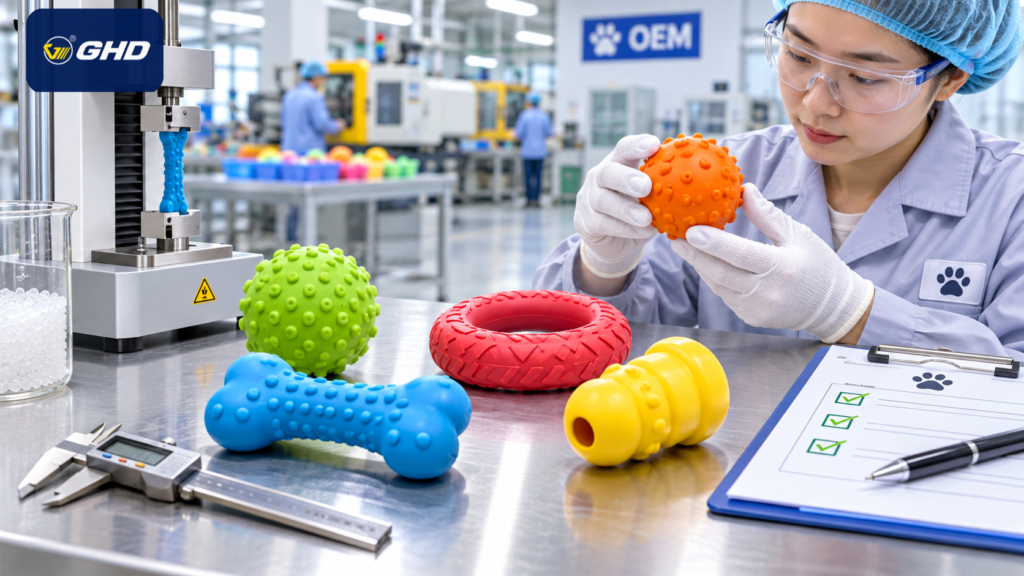
Tensile Strength Testing
Evaluates how a material behaves when subjected to pulling forces.
Tear Resistance Testing
Helps assess resistance to tearing, particularly around thin sections and stress points.
Component Retention Testing
Examines whether attached components remain secure under defined test conditions.
Repeated-Use Durability Testing
Evaluates product performance after repeated mechanical loading or deformation.
Chemical and Material Assessments
May be required to evaluate substances of concern and compliance with relevant market requirements.
There is no single test that guarantees every pet toy will be safe in every situation.
Testing plans should be based on foreseeable hazards, product specifications, and the requirements of the destination market.
5. Why Quality Control Is Essential in Mass Production
A successful prototype does not automatically guarantee consistent mass production.
Variations in material batches, molding parameters, assembly, and finishing may affect product performance.
A structured quality control process may include:
- Incoming material inspection.
- Verification of approved product specifications.
- In-process production monitoring.
- Finished-product inspection.
- Packaging and labeling verification.
Clear acceptance criteria help manufacturers and buyers maintain consistent expectations throughout production.
6. What Pet Brands Should Ask Their OEM Manufacturer
Before placing an order, pet brands should discuss several important questions with their manufacturing partner.
What materials will be used? What is the intended animal size and chewing category? Which failure modes have been considered? What testing is appropriate? How will production quality be monitored?
It is also important to clarify which test reports and compliance documents apply to the exact product being ordered.
A test result for one formulation or design does not automatically establish the performance of another.
7. How GHD PET Supports Pet Product Development
At GHD PET, we support OEM and ODM development of rubber, silicone, and plastic pet products for international brands and importers.
Our manufacturing approach includes product specification review, material selection discussions, tooling coordination, production, and quality control.
By identifying important product requirements early, we help customers evaluate manufacturing feasibility and define suitable quality expectations before moving toward mass production.
Conclusion: Safety Is More Than a Marketing Claim
Are all pet toys on the market really safe?
Being available for purchase does not guarantee that a product is suitable for every pet or every type of play.
Responsible pet toy development requires appropriate material selection, thoughtful engineering, relevant testing, and consistent quality control.
For pet brands, the right manufacturing partner should understand not only how to manufacture a product, but also how to identify and address potential product risks.
Looking for an OEM manufacturer for custom rubber or silicone pet toys?
Contact GHD PET to discuss your product specifications, intended use, material requirements, and manufacturing project.
Explore our OEM manufacturing capabilities at GHD PET.