Made in China vs. Made in Vietnam: Does Country Really Determine Product Quality?
Is a product made in China better than one made in Vietnam? Or is Vietnam becoming the better manufacturing choice?
This is a question many international pet product brands, importers, and sourcing managers face when evaluating OEM manufacturing partners.
For decades, China has been a major global manufacturing center. Meanwhile, Vietnam has become an increasingly important sourcing destination for businesses seeking greater supply chain diversification.
But when comparing Made in China vs. Made in Vietnam, one important question is often overlooked:
Does the country of manufacture actually determine product quality?
From a manufacturer’s perspective, the answer is no—not by itself.
The quality of a rubber dog toy, silicone feeding mat, or plastic pet accessory depends much more on the manufacturer’s technical capabilities, material specifications, production processes, and quality control systems than on the country printed on its packaging.
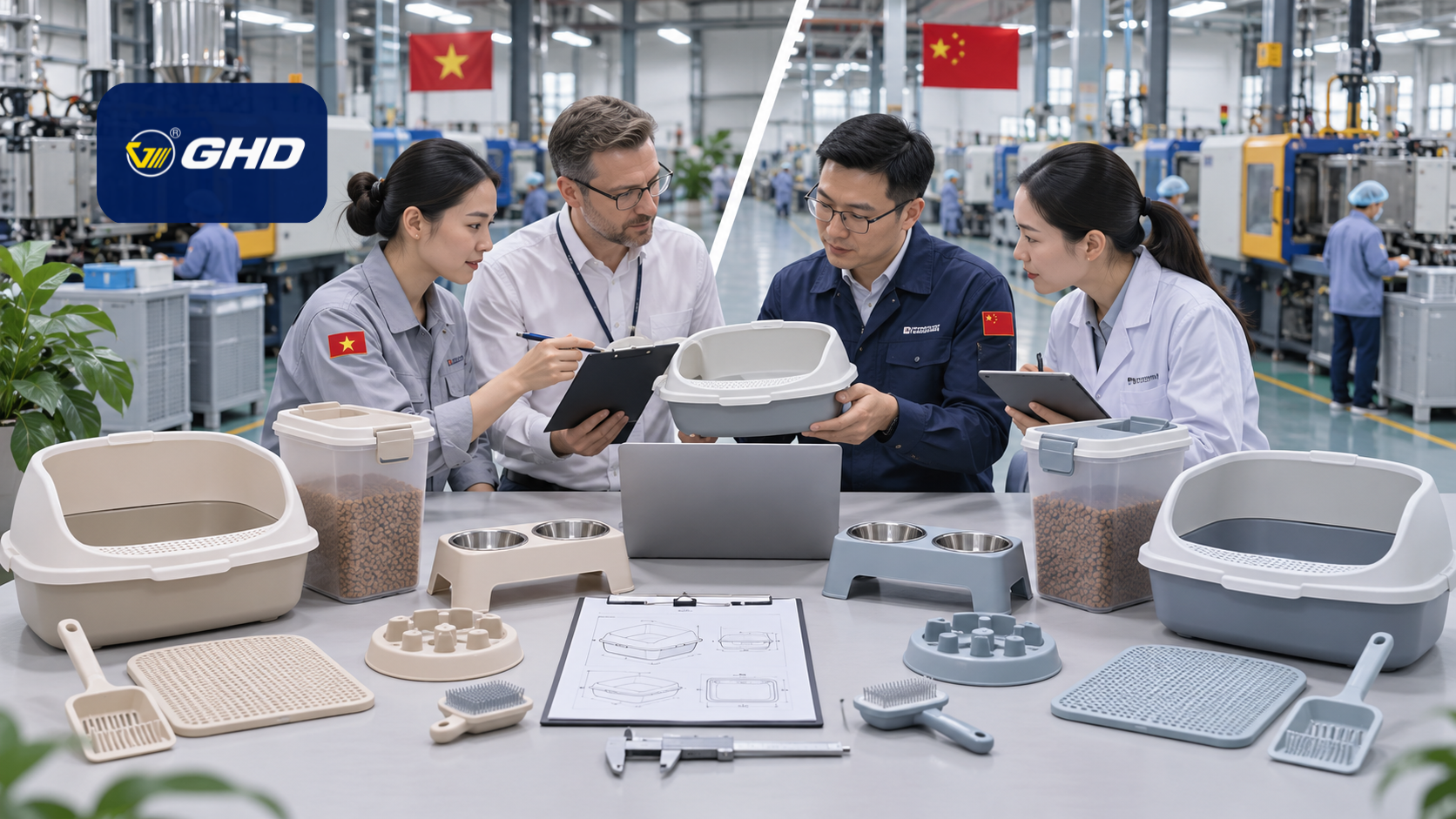
At GHD PET, our manufacturing network spans both Vietnam and China. This gives us a practical perspective on what truly matters when manufacturing pet products for international brands.
Let’s explore the differences and why manufacturing location should not be confused with manufacturing quality.
1. Made in China vs. Made in Vietnam: Understanding the Quality Debate
Country-of-origin labels can strongly influence how buyers perceive a product.
Some buyers associate Chinese manufacturing with established industrial supply chains, advanced production capabilities, and extensive tooling expertise.
Others increasingly associate Vietnam with supply chain diversification and an alternative manufacturing destination for international brands.
Both countries offer manufacturing opportunities, but neither country automatically guarantees superior product quality.
Within the same country, factories can differ significantly in terms of equipment, engineering expertise, workforce training, material sourcing, and inspection procedures.
A highly capable manufacturer in Vietnam may outperform a poorly managed factory in China.
Likewise, an experienced Chinese manufacturer may offer better production consistency than a Vietnamese supplier without the required technical capabilities.
The important distinction is between evaluating a country and evaluating an actual factory.
For professional sourcing decisions, factory-level capabilities matter more than assumptions about national origin.
2. Manufacturing Capabilities: The Foundation of Product Quality
Manufacturing quality begins with the factory’s ability to turn approved product specifications into consistent finished products.
Consider a simple rubber dog ball.
At first glance, two rubber balls may look nearly identical. They may have the same color, shape, dimensions, and surface texture.
However, their performance can differ considerably.
One may maintain its elasticity under repeated compression, while another may crack or tear sooner.
These differences can result from variations in material formulations, molding conditions, product design, and quality control.
What Defines a Capable Pet Product Manufacturer?
Important manufacturing capabilities include:
- Appropriate molding and production equipment.
- Experienced engineering and technical teams.
- Material formulation and processing knowledge.
- Product design and tooling expertise.
- Controlled production parameters.
- Clearly defined inspection procedures.
- The ability to maintain consistency across manufacturing batches.
For OEM and ODM pet products, these capabilities become particularly important when producing customized designs or scaling a product from prototype to mass production.
A factory should not be evaluated solely by its manufacturing location.
It should be evaluated by whether it has the technical resources required to manufacture the specific product.
3. Product Specifications: Quality Starts Before Production
One of the biggest misconceptions in OEM manufacturing is that product quality is determined entirely on the factory floor.
In reality, many important quality decisions are made before manufacturing begins.
A product’s technical specifications define what the factory is expected to produce.
For rubber, silicone, and plastic pet products, these specifications may include:
- Material type and formulation requirements.
- Product dimensions and tolerances.
- Hardness and flexibility.
- Tensile strength and tear resistance.
- Surface finish and color.
- Functional performance requirements.
- Chemical and mechanical testing requirements.
- Packaging and labeling specifications.
Why Specifications Matter More Than Appearance
Imagine two manufacturers producing the same-looking rubber chew toy.
Factory A uses one rubber formulation, while Factory B uses another.
Even if the finished toys appear identical, they may behave differently under stretching, biting, or repeated deformation.
Without clear specifications, it becomes difficult to determine whether the factories are manufacturing equivalent products.
This is why professional OEM projects should begin with agreed technical requirements.
If the specifications are different, comparing product quality based only on appearance or country of origin is misleading.
4. Quality Control: The Real Test of Manufacturing Consistency
Producing one excellent sample is not the same as consistently producing thousands of excellent products.
This is where quality control becomes essential.
For international pet brands, a manufacturing partner must be able to maintain agreed product requirements throughout production.
A structured quality control system can help achieve this through several stages.
Incoming Material Inspection
Raw materials are checked against relevant requirements before entering production.
This may include material identification, documentation, appearance, or specified physical properties.
In-Process Quality Control
Production conditions and product characteristics are monitored during manufacturing.
For molded pet products, important parameters may include molding temperature, pressure, curing conditions, cycle time, and dimensional consistency, depending on the process.
Final Product Inspection
Finished products are checked against approved specifications and acceptance criteria.
These checks may cover appearance, dimensions, assembly integrity, and relevant functional requirements.
Packaging Inspection
Packaging, labeling, product quantities, and other agreed requirements are reviewed before shipment.
A consistent quality control process helps identify variation and reduce the likelihood of nonconforming products reaching customers.
However, quality systems should be supported by actual production records and product-specific verification rather than marketing claims alone.
Quality consistency is a manufacturing discipline—not a geographical advantage.
5. Is Manufacturing in Vietnam Always Cheaper Than China?
Another common belief is that manufacturing in Vietnam must always be cheaper than manufacturing in China.
But this is not necessarily true.
Manufacturing costs depend on many factors beyond labor rates.
For rubber, silicone, and plastic pet products, these factors may include:
- Raw material prices and sourcing locations.
- Tooling and mold development.
- Product design complexity.
- Manufacturing equipment and efficiency.
- Order quantity and production setup.
- Inspection and testing requirements.
- Packaging and customization.
- Transportation and logistics.
For example, a factory with efficient production equipment and established material suppliers may achieve competitive manufacturing costs despite operating in a location with higher labor expenses.
Similarly, a factory with lower labor costs may face higher material transportation, equipment, or production setup costs.
The most meaningful comparison is therefore based on equivalent product specifications and manufacturing conditions.
Pet brands should also distinguish the factory quotation from the total landed cost, which may include freight, insurance, customs duties, and other import-related expenses.
6. GHD PET: Manufacturing in Both Vietnam and China
At GHD PET, we believe international pet brands should have more flexibility when deciding where to manufacture their products.
Rather than limiting customers to a single production country, our manufacturing network includes facilities and technical resources across both Vietnam and China.
Manufacturing in Vietnam
Our Vietnam manufacturing operations include facilities in Hai Phong and Hung Yen.
These facilities support OEM and ODM projects involving silicone, rubber, and plastic products for international customers.
Manufacturing in China
Our China manufacturing and engineering network includes operations in Dongguan and product development resources in Shenzhen.
This provides additional manufacturing and technical support for suitable projects.
One Manufacturing Partner, Two Country Options
By working across both countries, GHD PET offers customers the opportunity to discuss their preferred manufacturing location through one manufacturing network.
For eligible projects, our goal is to offer comparable manufacturing pricing and aligned quality requirements, whether customers choose production in Vietnam or China.
The actual manufacturing location, availability, quotation, and production arrangement are confirmed according to product specifications and project requirements.
This approach allows customers to consider their broader sourcing strategy without automatically assuming that one production country must deliver better quality or lower prices.
Two manufacturing locations. Comparable pricing. Customer-defined quality requirements. Your choice.
7. Why Dual-Country Manufacturing Matters for Pet Brands
Having manufacturing options in both China and Vietnam can offer practical benefits for international sourcing teams.
Greater Supply Chain Flexibility
Brands can evaluate manufacturing locations according to business requirements, available capacity, and supply chain planning.
Rather than depending on a single location, buyers may have additional production options for suitable projects.
More Strategic Sourcing Decisions
Some customers prioritize manufacturing in Vietnam as part of their sourcing diversification strategy.
Others may prefer China because of existing supplier relationships, component availability, or logistical requirements.
The ability to discuss both options with one manufacturing partner can simplify the early supplier evaluation process.
Coordinated Product Development
A multi-country manufacturing network can bring together engineering, tooling, and production resources.
For OEM and ODM projects, coordination is important when transferring approved designs, production specifications, and quality requirements between facilities.
However, equivalent performance should never be assumed solely because factories belong to the same network.
Each production location must be capable of manufacturing the particular product and meeting its acceptance criteria.
Competitive Manufacturing Pricing
At GHD PET, comparable pricing between our Vietnam and China manufacturing options is an important part of our customer offering for suitable projects.
This allows customers to assess sourcing location based on additional business factors rather than assuming that a country change must involve a major manufacturing price difference.
Final quotations remain subject to material requirements, production feasibility, order quantities, tooling, and commercial terms.
8. How Can Brands Maintain Consistent Quality Across Two Countries?
When producing similar products in different manufacturing locations, quality consistency requires careful planning.
The objective should be to ensure that products meet the same approved requirements, regardless of where they are manufactured.
Important practices include:
Shared Product Specifications
Both facilities should work from the same approved drawings, material specifications, product requirements, and quality acceptance criteria.
Controlled Materials
Materials and formulations should be verified against the agreed requirements.
If material suppliers or formulations differ between production locations, their suitability should be assessed rather than assumed.
Tooling and Process Validation
Tooling, equipment settings, and manufacturing processes may need to be validated for each location.
A successful production process at one factory does not automatically guarantee identical results at another.
Consistent Inspection Criteria
Each production location should apply agreed inspection methods and acceptance criteria.
Sample Approval and Production Verification
Samples and initial production results should be evaluated before approving a new manufacturing location for ongoing production.
This helps reduce the risks associated with transferring a product between factories.
For GHD PET customers, defining these requirements early is an important part of discussing dual-country manufacturing arrangements.
9. China or Vietnam: Which Manufacturing Location Should You Choose?
The right choice depends on your business strategy.
Manufacturing in Vietnam may be attractive for brands pursuing additional sourcing options outside China.
Manufacturing in China may be appropriate for projects that benefit from established tooling, material, component, or manufacturing resources.
Neither location should be chosen based on assumptions alone.
Before making a decision, consider:
- Can the selected facility manufacture the required product?
- Are the technical specifications and quality requirements clearly defined?
- What is the total manufacturing and landed cost?
- What production capacity and delivery schedule are available?
- Are there relevant country-of-origin, customs, or tariff considerations?
- Can the manufacturer support future product development and quality consistency?
Country-of-origin requirements and applicable tariffs should be evaluated according to the actual manufacturing process and destination market.
Selecting a production location does not automatically establish eligibility for preferential tariff treatment.
A reliable manufacturing partner should help customers understand the practical production options without making unsupported assumptions about cost or product quality.
10. Why Choose GHD PET for OEM and ODM Pet Product Manufacturing?
GHD PET supports international pet brands, importers, distributors, and private-label businesses with custom manufacturing services.
Our core capabilities cover silicone, rubber, and plastic pet products.
We work with customers on product specifications, material selection, tooling coordination, sampling, production, quality expectations, and customization requirements.
Our Vietnam and China manufacturing network provides additional location flexibility for suitable projects.
We believe the strongest manufacturing relationships are built on transparent specifications, realistic production planning, consistent quality control, and clear communication.
Whether your sourcing strategy focuses on Vietnam, China, or both, our team can discuss the most appropriate manufacturing arrangement for your project.
Conclusion: Quality Is About the Factory, Not Just the Country
So, does Made in China or Made in Vietnam determine product quality?
Not by itself.
Manufacturing location can influence sourcing decisions, logistics, commercial conditions, and access to certain industrial resources.
But product quality depends primarily on the capabilities of the factory, the specifications it follows, and the effectiveness of its manufacturing and quality control processes.
For international pet brands, the objective should not be to choose a country based on reputation alone.
It should be to find a manufacturing partner capable of delivering the required product quality consistently.
At GHD PET, we bring together manufacturing resources in Vietnam and China, offering eligible customers comparable pricing and greater production location flexibility.
Why choose between Vietnam and China when you can explore both options with one manufacturing partner?
Looking for an OEM Pet Products Manufacturer in Vietnam or China?
GHD PET supports custom rubber, silicone, and plastic pet product manufacturing for international brands.
Contact our team to discuss your product specifications, order quantities, quality requirements, and preferred manufacturing location.
Same manufacturing partner. Two production options. Your sourcing strategy.
Website: https://ghdpet.com
Request a Quote: https://ghdpet.com/contact-us/